

Another fabulous Entrepreneurs Christmas Party to round out a successful year for Bondi Innovation and the local innovation community!
In this post:
- Recap of the AI-Accelerated Startups panel
- The party
- Pics!
Recap of the AI-Accelerated Startups panel
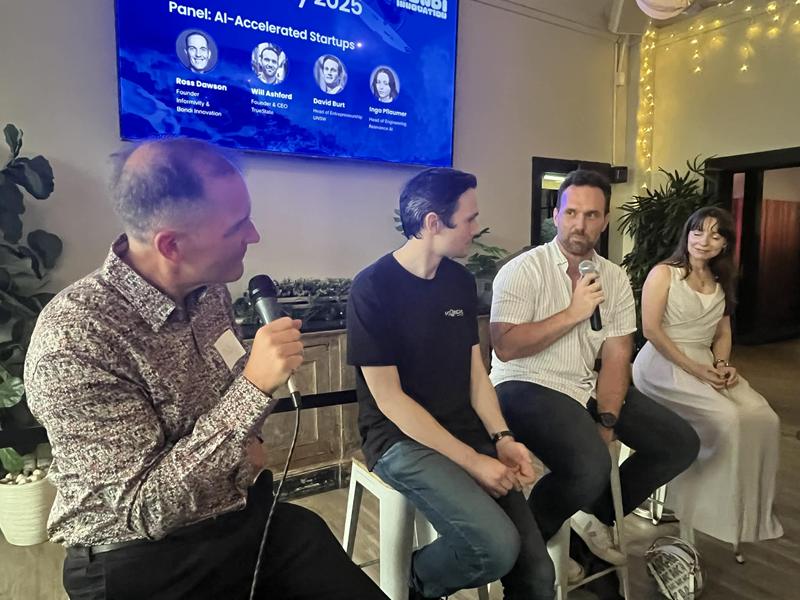
Our all-star panel on AI-Accelerated Startups:
Will Ashford, Founder & CEO, TrueState
David Burt, Head of Entrepreneurship, UNSW
Inga Pflaumer, Head of Engineering, Relevance AI
Here were the major themes of the conversation:
The big theme: AI as a human amplifier, not a human replacement
The discussion pushed back on the “AI destroys human connection” storyline. The more interesting claim was the opposite: AI can give human connection back by automating the work that quietly steals it. In operational environments, that means offloading repetitive analysis, reporting, and coordination so leaders can spend more time talking to people, coaching performance, and solving the hard human parts. The forward-looking question was practical: what can I automate next year so I can do more relevant, more impactful work myself?
Startups are shrinking, which changes who gets to play
One vivid founder moment anchored this: the pain of pressing send on payroll. That became a bridge to a key data point and its implication: it’s now plausible to build startups with roughly half the headcount compared to two years ago. There was both optimism and realism. Fewer roles and fewer graduate jobs can be brutal, but the counterweight is that the barriers to shipping a product or service are falling fast. The thread extended to researchers too: tighter funding can become a catalyst for more scientists to start companies and commercialize.
The real moat: what only you have
The best story here was boats, barnacles, and datasets. A simple pain point (cleaning boat hulls is expensive, so it’s done rarely) became a company using robots plus computer vision to clean hulls far more frequently, with reported outcomes like 20–30% reductions in fuel bills for ferry operators and $16M raised. The punchline wasn’t “robots.” It was that the business created what may be one of the richest datasets of underwater hull imagery. The theme was clear: when tools are widely available, defensibility often comes from unique data, access, or distribution you can accumulate over time.
AI is “slop” without frameworks
A blunt line landed: without frameworks, AI is just crap in, crap out, and the output becomes confident noise. The nuance mattered: AI is genuinely valuable for founders and small teams because it provides access to structured thinking and fast learning, even in unfamiliar domains like marketing. But it only works if you bring discipline: identify relevant frameworks, pressure-test assumptions, and use AI to extend cognition rather than replace it.
Quiet operational wins beat flashy demos
Not all value is sexy. A concrete example was security operations: intrusion and scanning attempts create so much noise that teams end up tuning it out. Applying LLMs to triage and summarize turned “50 alerts a day” into something closer to “one real thing every six months.” The deeper point is that AI’s ROI often comes from attention management inside workflows: reducing alert fatigue, restoring signal, and improving response quality.
Communication is leverage, not a nice-to-have
AI can compress the cost of turning dense internal reviews into something people actually absorb. A “slide builder” example showed how operational metrics and engineering retros can become full presentations with visuals, playful styles, even animations. It sounds lightweight, but the claim was strong: when information becomes more legible and engaging, people become more receptive, alignment improves, and ideas travel faster. The theme wasn’t “make it pretty.” It was: make insight move.
Build first, let reality steer the venture
A consistent thread was that you can’t plan your way into traction. Start building even if the first version is terrible, talk to people, and follow the pull of what users will pay for. The standout story captured this: an “asteroid mining” startup couldn’t raise for mining, so it solved a nearer problem with space-object imagery, then discovered the real demand was satellite imagery and pivoted. A twist of timing and geography created an edge, culminating in a cited $100M US government contract. The closing counterpoint was equally sharp: don’t treat AI as your cofounder. Find human accountability early, because tools will collaborate endlessly, but they won’t reliably challenge your blind spots.
The party

Pics!