
The first AI for Product Management and Go-to-Market gathering brought together a highly practical group of founders, product leaders, designers, consultants, AI builders, and go-to-market practitioners to explore how AI is changing the way products are imagined, built, launched, sold, and improved.
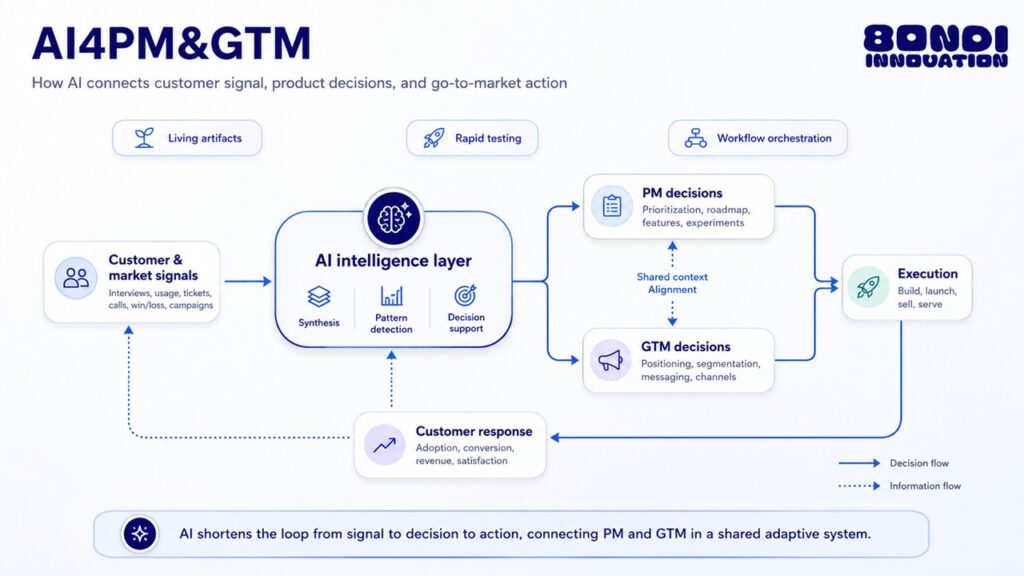
Rather than treating AI as a generic productivity tool, the event focused on a more useful question: how can AI become part of the working system that connects product development, customer learning, market engagement, and revenue growth?
The session was deliberately exploratory. It combined informal tool comparisons, participant introductions, live examples, and open discussion about where AI is already creating value, where it still falls short, and what this group could become over time.
What happened
The event opened with a lively discussion about AI-assisted design and prototyping tools, including Lovable, Bolt, Figma Maker, Claude CoWork, and AI coding agents. Participants compared experiences using these tools to build prototypes, generate interfaces, create specifications, and move faster from idea to something tangible.
A strong theme emerged early: AI can accelerate product creation, but it does not automatically create good design. Several participants noted the sameness of many AI-generated products: familiar layouts, dark themes, predictable interface patterns, and weak differentiation. Experienced designers still play a crucial role in bringing taste, visual judgment, brand coherence, and product feel.
This led to a valuable discussion about how to guide AI more effectively through screenshots, design parameters, typography, colour systems, spacing rules, and reusable design systems. The takeaway was not that AI replaces design judgment, but that it can amplify it when given the right inputs and constraints.
The group then shifted into introductions, with each participant sharing what they are working on and why the topic is relevant to them. The range was impressive: construction approval software, AI-enabled knowledge platforms, B2B SaaS products, AI agents for consumer complaints, product-to-revenue consulting, AI-powered go-to-market systems, agentic workflow design, and AI-assisted venture building.
This made clear that the group is not simply interested in AI tools. It is interested in how AI changes the operating model for building and growing companies.
Key themes from the discussion
AI prototypes are thinking tools
One of the strongest insights was that prototypes have value even when they are not used directly. An AI-generated prototype can help a team clarify what it wants, expose assumptions, create a shared reference point, and generate specifications for a more robust build.
This reframes prototyping as part of the thinking process, not just the production process.
Human taste remains a differentiator
The conversation around design highlighted a central tension in AI product development. AI tools can produce polished-looking outputs quickly, but they often fall back into familiar patterns. The more products are created with the same tools, the more important human taste, judgment, and originality become.
The opportunity is to use AI for speed while preserving the distinctiveness that comes from experienced human direction.
Product and go-to-market are becoming more connected
Several participants were wrestling with the same challenge from different angles: how to connect product development with market learning and revenue generation.
For early-stage companies in particular, the issue is often not building the product. It is moving from product to revenue: defining the right customer, understanding the market, reaching prospects, learning from feedback, and improving the offer.
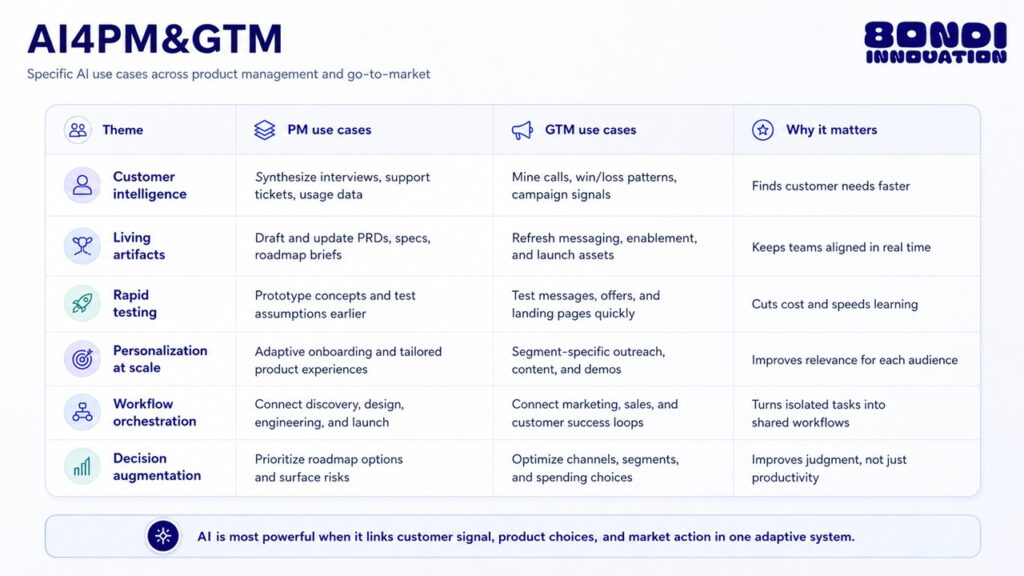
AI has the potential to strengthen those loops, helping teams gather signals, refine messaging, identify prospects, generate outreach, and feed market insights back into product decisions.
AI-enabled GTM is a major area of demand
One of the clearest needs surfaced in the session was for practical AI-supported go-to-market systems.
Participants were interested in using AI to help with:
- identifying ideal customer profiles
- finding relevant accounts and prospects
- sourcing contact information
- generating outreach sequences
- producing social and marketing content
- tracking responses and learning from them
- improving positioning and messaging over time
There was strong interest in making GTM less random and more systematic without pretending that it can be fully automated without human judgment.
AI coding tools are changing who can build
Another important thread was the rise of AI coding tools and their implications for founders, product managers, program managers, consultants, and non-traditional developers.
Participants were interested in how people can move from intent to specification to working product using AI tools, while still managing quality, scalability, and implementation risks. This suggests a valuable future focus on the practical craft of working with coding agents: how to write better specs, structure projects, review outputs, and know when to intervene.
Outcomes from the event
The event surfaced a clear appetite for a practical, peer-led group focused on AI at the intersection of product, design, build, and go-to-market.
The strongest outcome was the recognition that the room contained highly complementary expertise. Some participants brought product and design experience. Others brought GTM, SaaS, consulting, AI agents, workflow design, or venture-building perspectives. Together, this creates the potential for a group that learns through live examples rather than abstract discussion.
Several promising directions emerged:
A shared learning community for AI product and GTM practitioners
The group can become a space where builders compare tools, workflows, prompts, failures, and real implementation lessons.
A practical forum for live cases
Future sessions could use participant products or GTM challenges as working examples, creating immediate value for the person presenting and useful lessons for everyone else.
A source of reusable artifacts
Each event could produce a tangible output: a workflow map, prompt pack, tool comparison, GTM template, design checklist, or spec-to-build guide.
A living AI PM/GTM playbook
Over time, the group could build a shared body of knowledge on how AI is being used across product development, customer learning, design, sales, marketing, and company operations.
Suggestions for future events
The next events should lean into the group’s most valuable quality: it is made up of people actively building and applying AI, not just observing it.
Strong formats would include:
AI GTM Engine Working Session
A live session building an AI-assisted GTM workflow from start to finish: ICP definition, account discovery, prospect research, messaging, outreach sequences, content generation, and feedback loops.
AI Product Prototyping Show-and-Tell
Three or four participants show something they have built or attempted, covering what worked, what failed, what tools they used, and what they would do differently.
Escaping Generic AI Design
A focused session on how to use AI tools without producing generic interfaces. This could cover screenshots, design systems, brand constraints, typography, spacing, layout, interaction feel, and when to step outside the tool.
From Spec to Implementation
A practical session on using AI coding agents effectively, especially for PMs, founders, consultants, and program managers. The focus would be on writing better specs, managing the build process, creating acceptance criteria, and reviewing AI-generated outputs.
Product-to-Revenue Clinic
A structured session where participants bring live challenges around moving from product to customers, revenue, and repeatable GTM. This would directly address one of the strongest needs surfaced in the room.
Human + Agent Workflow Design
A more advanced session on designing workflows where humans and AI agents take complementary roles across product, GTM, customer support, research, and operations.